
How To Write Urdu Poetry Using DeepSeek Complete Prompt Guide
Write Urdu Poetry Using DeepSeek
Most people are using DeepSeek to write emails and code. But a growing number of Urdu literature lovers in Pakistan have figured out something much more interesting: this AI can write ghazals, nazms, and shayari that actually sound like they came from a human poet.
The results are not always perfect on the first try. The secret lies entirely in how you write your prompt. A vague instruction gives you generic verse. A structured, well-formed prompt gives you something that reads like it belongs in a poetry anthology. This guide covers exactly what works.
DeepSeek For Lawyers In Pakistan Legal Research Kaise Karein 2026
Quick Answer
To write Urdu poetry using DeepSeek, open the chat and give it a detailed prompt that includes: the poetry type (ghazal, nazm, qita), the topic or emotion, the language style (classical or modern), the radif and qafia if writing a ghazal, and the tone. The more specific your prompt, the better and more authentic the output.
Quick Info Table
| Feature | Details |
| Tool Name | DeepSeek AI (DeepSeek-V3 / R1) |
| Best For | Ghazal, Nazm, Qita, Marsiya, Rubai |
| Language Support | Urdu, Roman Urdu, Hindi |
| Prompt Language | You can prompt in English or Urdu |
| Availability in Pakistan | Free via deepseek.com |
| Cost | Free (basic use) |
| Ideal Users | Writers, poets, students, content creators |
How To Use DeepSeek Without Internet Offline Mode Complete Guide
Why DeepSeek Works Better Than Other AI Tools for Urdu Poetry
DeepSeek has trained on a large multilingual dataset that includes significant Urdu and Persian literary text. This gives it a working understanding of classical Urdu poetic conventions that tools like standard ChatGPT sometimes miss or approximate poorly.
When you ask DeepSeek for a ghazal, it actually knows what a maqta is. It understands that the radif comes after the qafia, that the sher must be complete in meaning on its own, and that the mazmoon should carry consistent emotional weight throughout. These are things most AI tools get wrong without very detailed instructions.
DeepSeek API Free Tier Limits Explained For Pakistani Developers 2026
What Types of Urdu Poetry Can DeepSeek Write?
DeepSeek handles a wider range of Urdu poetic formats than most people expect. Before you start prompting, knowing which form you want helps you give cleaner instructions.
Formats DeepSeek handles well:
- Ghazal — The most popular form. DeepSeek can maintain radif, qafia, and maqta structure when clearly instructed.
- Nazm — Free verse or structured. Works well for emotional, narrative, or political themes.
- Rubai — Four-line poetry in the style of Omar Khayyam or Mir. Great for philosophical themes.
- Qita — Thematic verse without the maqta rule. Useful for social commentary.
- Marsiya — Elegiac poetry. DeepSeek handles solemn, spiritual tones well.
- Hamd and Naat — Devotional poetry. Requires careful prompting for authenticity.
How To Use DeepSeek Voice Feature On Android In Pakistan Step By Step
How To Write the Perfect Prompt for Urdu Shayari
This is where most people fail. They type “write me a ghazal about love” and get something generic. The prompt structure below consistently produces better results.
The Core Prompt Formula
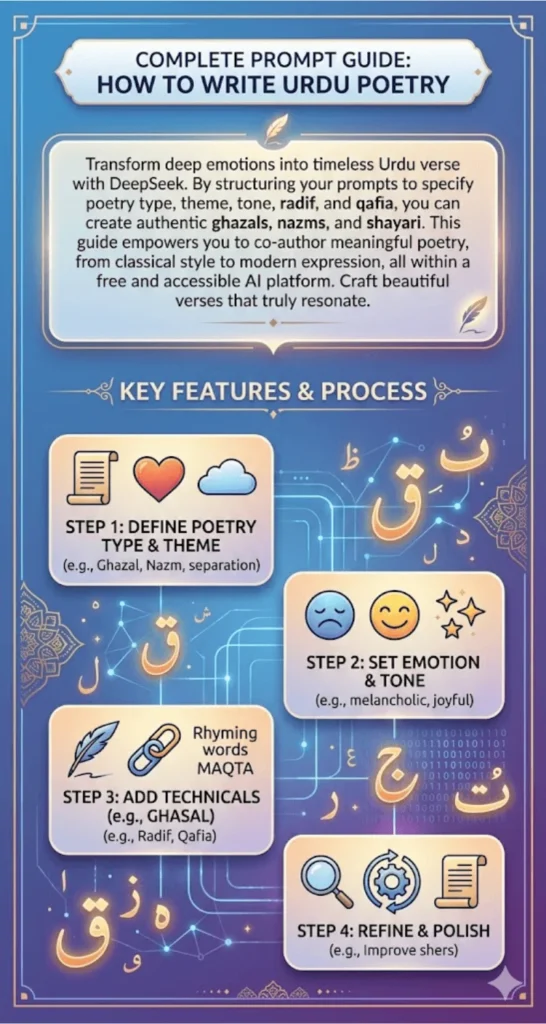
A good DeepSeek poetry prompt has five parts: the form, the subject, the emotional register, the linguistic style, and the technical requirements.
Write your prompt like this: “Write a [form] in Urdu on the theme of [topic]. The tone should be [sad/romantic/philosophical/angry]. Use [classical/modern/mixed] language. The radif should be [your chosen word or phrase] and maintain proper qafia throughout. Include a maqta in the last sher.”
That single structured instruction produces dramatically better output than a casual request.
Prompt Examples That Actually Work
For Ghazal: “Write a 7-sher Urdu ghazal on the theme of separation (judaai). Use classical Urdu vocabulary. The radif should be ‘raha nahi’ and maintain consistent qafia. The tone should be melancholic. Include a maqta in the last sher where the poet’s name or identity is referenced.”
For Nazm: “Write a modern Urdu nazm of 20 to 25 lines on the theme of a mother’s silence. Use conversational yet literary Urdu. Avoid archaic words. The tone should be emotionally restrained, not dramatic. Organize it in 4 stanzas.”
For Rubai: “Write 5 rubais in the style of classical Persian-influenced Urdu poetry on the theme of time passing. Use words from the Persian-Urdu literary tradition. Keep each rubai self-contained in meaning.”
DeepSeek V4 Pro vs V4 Flash Which Model Should You Use in Pakistan 2026
Controlling the Language Register in Your Prompts
One of the most useful features of DeepSeek for Urdu poetry is that you can control how classical or modern the language feels. This matters because many readers want different things.
If you are writing for a social media audience, you want modern Urdu that people can read without a dictionary. If you are writing for a mushaira or a literary publication, classical vocabulary carries more weight and authenticity.
Tips for controlling register:
- Say “use simple, everyday Urdu words” for accessible poetry
- Say “use classical Urdu with Persian and Arabic influence” for literary output
- Mention specific poets whose style you want to reference: “in the style of Faiz Ahmed Faiz” or “inspired by Mirza Ghalib’s mazmoon”
- Ask for Roman Urdu output if you need it for digital platforms
- Specify “avoid English loanwords” if you want pure literary Urdu
DeepSeek Login Problems 2026 Fix “Email Already Exists” and OTP Not Received Errors
How To Refine DeepSeek’s Output After the First Draft
The first output is a starting point, not a final product. Most good poets using AI tools treat it like a co-writer, not a ghostwriter. After DeepSeek gives you the first draft, read each sher independently. A proper sher should carry complete meaning on its own. If any sher feels incomplete or the radif feels forced, ask DeepSeek to revise just that sher.
Useful follow-up prompts:
- “The third sher feels weak. Rewrite it with a stronger image while keeping the same radif and qafia.”
- “The qafia in sher 4 and sher 6 is the same word. Change one of them to a new qafia that rhymes.”
- “Add more emotional weight to the opening sher (matla). It should immediately set the mood.”
- “The maqta feels too direct. Make it more subtle while keeping the poet-reference tradition.”
How To Create A DeepSeek Account From Pakistan Fix Phone Verification Issues
Common Mistakes When Prompting DeepSeek for Urdu Poetry
Mistakes to avoid:
- Asking without specifying the form. “Write Urdu poetry” is too vague.
- Not mentioning radif and qafia for ghazals. The AI will guess and often guess wrong.
- Asking for too many shers at once. Five to seven shers is ideal. More shers often lead to weaker middle verses.
- Not specifying Roman Urdu vs. Nastaliq script. By default, DeepSeek writes in script form.
- Ignoring the maqta. Always ask for it explicitly if you want a traditional ghazal.
- Using emotional adjectives without context. “Write something sad” is less effective than “write about a person who has lost someone and cannot cry.”
How To Earn Money With DeepSeek 7 Real Methods For Pakistani Freelancers 2026
Using DeepSeek for Urdu Poetry on Pakistani Digital Platforms
Pakistani content creators on Instagram, YouTube, and Facebook have started using AI-generated Urdu shayari for videos, quote graphics, and caption content. DeepSeek’s free access at deepseek.com makes it practical for this use without any subscription cost.
For social media use, prompt specifically for shorter formats: two-sher couplets work better than full ghazals for graphic content. Ask for Roman Urdu if your audience reads primarily in that format. And always review the output before publishing because AI can occasionally produce grammatical errors in Urdu that native speakers catch immediately.
DeepSeek vs Gemini vs Claude Which AI Is Best For Pakistan In 2026?
FAQ
Can DeepSeek write Urdu poetry in Nastaliq script?
Yes. By default it writes in Urdu script. If you want Roman Urdu, mention it in your prompt.
Is DeepSeek free to use for Urdu poetry in Pakistan?
Yes, the basic version at deepseek.com is free and accessible in Pakistan without a VPN.
Which DeepSeek model is best for creative Urdu writing?
DeepSeek-V3 handles creative tasks like poetry better than the R1 reasoning model, which is designed for logic.
Can I ask DeepSeek to write poetry in the style of Ghalib or Faiz?
Yes. Mentioning a specific poet’s name in your prompt helps DeepSeek match the vocabulary, imagery, and emotional register of that style.
Does DeepSeek understand the rules of ghazal like radif and qafia?
It does, but only if you mention them. Always specify radif and qafia explicitly in your prompt.
Can DeepSeek write Hamd or Naat poetry?
Yes, it can. Mention that it is devotional poetry and specify the tone as respectful and formal for better results.
What if the output has grammatical mistakes in Urdu?
Ask it to review the sher in question. You can paste the line and say “check this for grammatical accuracy in Urdu” and it will usually catch its own errors.
DeepSeek API Price In Pakistan 2026 Complete Cost Breakdown In PKR
Conclusion
DeepSeek is not replacing Urdu poets. What it is doing is giving writers, students, and enthusiasts a tool to experiment with a literary tradition that has strict and beautiful rules. The quality of what comes out depends almost entirely on the quality of what goes in. Once you learn to prompt with the precision that classical Urdu poetry deserves, you will find that DeepSeek produces verse that surprises you. The poets who will get the most from this tool are those who already know enough about ghazal and nazm to know when the AI gets it wrong and when it gets it exactly right. That editorial eye, combined with a well-structured prompt, is where the real creative work happens.
DeepSeek vs Gemini vs Claude Which AI Is Best For Pakistan In 2026?